Why Do People Say Babies Are the Best Scientist
/https://tf-cmsv2-smithsonianmag-media.s3.amazonaws.com/filer/Born-to-Be-Mild-angel-devil-631.jpg)
Arber Tasimi is a 23-year-old researcher at Yale University's Baby Noesis Eye, where he studies the moral inclinations of babies—how the littlest children sympathize right and wrong, before language and civilization exert their deep influence."What are we at our core, before anything, earlier everything?" he asks. His experiments draw on the work of Jean Piaget, Noam Chomsky, his own undergraduate thesis at the University of Pennsylvania and what happened to him in New Haven, Connecticut, i Fri nighttime last February.
It was almost 9:45 p.m., and Tasimi and a friend were strolling home from dinner at Buffalo Wild Wings. Just a few hundred feet from his apartment edifice, he passed a group of young men in jeans and hoodies. Tasimi barely noticed them, until one landed a punch to the dorsum of his head.
There was no fourth dimension to run. The teenagers, ignoring his friend, wordlessly surrounded Tasimi, who had crumpled to the brick sidewalk. "It was seven guys versus ane aspiring PhD," he remembers. "I started counting punches, one, two, 3, four, five, 6, vii. Somewhere along the way, a knife came out." The bract slashed through his winter coat, just missing his skin.
At concluding the attackers ran, leaving Tasimi prone and weeping on the sidewalk, his left arm broken. Police afterward said he was likely the random victim of a gang initiation.
Later surgeons inserted a metal rod in his arm, Tasimi moved back home with his parents in Waterbury, Connecticut, about 35 minutes from New Haven, and became a creature much like the babies whose social lives he studies. He couldn't shower on his own. His mom done him and tied his shoes. His sister cut his meat.
Spring came. I beautiful afternoon, the temperature soared into the 70s and Tasimi, whose purple and yellowish bruises were notwithstanding healing, worked up the courage to stroll exterior past himself for the beginning time. He went for a walk on a nearby jogging trail. He tried non to notice the 2 teenagers who seemed to be following him. "Terminate catastrophizing," he told himself over again and once again, up until the moment the boys demanded his headphones.
The mugging wasn't violent but information technology broke his spirit. Now the whole world seemed menacing. When he at last resumed his morality studies at the Babe Knowledge Center, he parked his car on the street, feeding the meter every few hours rather than risking a shadowy parking garage.
"I've never been this low in life," he told me when we get-go met at the infant lab a few weeks subsequently the 2d crime. "You can't help wonder: Are we a failed species?"
At times, he said, "simply my research gives me hope."
***
The study of babies and immature toddlers is a perplexing business. Even the most perceptive observers can be tempted to encounter what isn't there. "When our infant was only four months old I thought that he tried to imitate sounds; but I may have deceived myself," Charles Darwin wrote in "A Biographical Sketch of an Infant," his classic study of his own son. Babies don't reliably control their bodies or communicate well, if at all, and so their opinions tin can't be solicited through ordinary means. Instead, researchers outfit them with miniature wire skullcaps to monitor their encephalon waves, scrutinize them like shoplifters through video cameras and 2-way mirrors, and behave exceedingly clever and tightly controlled experiments, which a good portion of their subjects will turn down to sit through anyway. Fifty-fifty well-behaved babies are notoriously tough to read: Their most meditative expressions are frequently the sign of an impending bowel movement.
Only tiny children are also some of psychology's nearly powerful muses. Because they accept barely been exposed to the world, with its convoluted cultures and social norms, they represent the raw materials of humanity: who we are when we're born, rather than who we get. Benjamin Spock's famous book, Dr. Spock's Baby and Child Care, "starts out with the judgement 'You know more than you think you do,'" says Melvin Konner, an Emory University anthropologist and medico and the author of The Evolution of Childhood. "In that location'southward some other point that needs to be made to parents: Your babe knows more than you think she knows. That's what'southward coming out of this kind of enquiry."
The 1980s and '90s brought a series of revelations virtually very young babies' sophisticated perceptions of the concrete world, suggesting that we come up to life equipped with quite an extensive tool kit. (Tin five-calendar month-olds count? Admittedly. Practice they understand simple physics? Aye.) Recently, some labs have turned to studying infants' inborn social skills, and how babies perceive and assess other people's goals and intentions. Scrutinizing these functions, scientists hope, will reveal some innate features of our minds—"the nutshell of our nature," says Karen Wynn, director of the Yale lab.
"People who've spent their whole careers studying perception are now turning toward social life, considering that's where the bio-behavioral rubber meets the evolutionary route," Konner says. "Natural selection has operated every bit much or more on social behavior as on more basic things like perception. In our evolution, survival and reproduction depended more and more on social competence equally you lot went from basic mammals to primates to human ancestors to humans."
The Yale Infant Cognition Eye is particularly interested in one of the most exalted social functions: ethical judgments, and whether babies are hard-wired to make them. The lab'south initial study along these lines, published in 2007 in the journal Nature, startled the scientific globe by showing that in a series of simple morality plays, 6- and x-calendar month-olds overwhelmingly preferred "expert guys" to "bad guys." "This capacity may serve as the foundation for moral thought and action," the authors wrote. It "may form an essential basis for...more than abstruse concepts of right and wrong."
The terminal few years produced a spate of related studies hinting that, far from being built-in a "perfect idiot," every bit Jean-Jacques Rousseau argued, or a selfish brute, every bit Thomas Hobbes feared, a kid arrives in the earth provisioned with rich, broadly pro-social tendencies and seems predisposed to care almost other people. Children can tell, to an extent, what is good and bad, and frequently human action in an altruistic way. "Giving Leads to Happiness in Young Children," a study of under-2-year-olds concluded. "Babies Know What'due south Fair" was the event of another study, of 19- and 21-month-olds. Toddlers, the new literature suggests, are particularly equitable. They are natural helpers, aiding distressed others at a cost to themselves, growing concerned if someone shreds another person'southward artwork and divvying up earnings later on a shared task, whether the spoils take the form of detested rye bread or precious Gummy Bears.
This all sounds like cheering news for humanity, peculiarly parents who nervously chant "share, share, share" every bit their children navigate the communal toy box. Indeed, some of these studies suggest that children'due south positive social inclinations are so deeply ingrained that it doesn't thing what parents say or practise: A Harvard experiment, nicknamed "The Large Mother Study" (as in Large Mother Is Watching You), showed that small-scale children helped others whether or non a parent commanded them to assist or was even nowadays.
These findings may seem counterintuitive to anyone who has seen toddlers pull hair in a playground tunnel or pistol-whip one another with a plastic triceratops. Twenty-four hour period to twenty-four hours, babies can seem unfeeling and primitive, or at the very least unfathomably bizarre, afraid of donkeys one minute and the moon the side by side, their prismatic minds beaming nonsense and non sequiturs instead of the secrets of our higher nature. No seasoned parent can believe that nurture doesn't make a difference, or that nature trumps all. The question is where the residue lies.
"Where morality comes from is a really difficult problem," says Alison Gopnik, a developmental psychologist at the University of California at Berkeley. "There isn't a moral module that is in that location innately. But the elements that underpin morality—altruism, sympathy for others, the understanding of other people's goals—are in place much earlier than we thought, and clearly in place before children turn 2."
***
Though housed in a stern stone edifice on the Yale campus, the baby cognition lab is a happy nest of an office with a comfy couch, meant to exist torn apart by one tornado of a toddler afterward another, and huge, sunlight-streaming windows, through which researchers spy on approaching strollers. Ranging in age from three months to ii years, the visiting infants are elaborately received by staff members who crawl around on the floor with them while parents sign consent forms. (A fiddling-known expense of this line of research is the cost of new pants: The knees wear out fast.) In the back room, the atmosphere is less cozy. There'southward lots of weird stuff lying around: plastic molds of Cheerios, houseplants that accept been spray-painted silver.
Infant morality studies are so new that the field's m dame is 29-year-onetime J. Kiley Hamlin, who was a graduate educatee at the Yale lab in the mid-2000s. She was spinning her wheels for a thesis project when she stumbled on blithe presentations that one of her predecessors had made, in which a "climber" (say, a crimson circle with goggle eyes) attempted to mount a hill, and a "helper" (a triangle in some trials) assisted him, or a "hinderer" (a square) knocked him downwards. Previous infant enquiry had focused on other aspects of the interaction, but Hamlin wondered if a babe observing the climber's plight would prefer one interfering character over another.
"Every bit adults, we like the helper and don't like the hinderer," says Hamlin, now an assistant professor at the University of British Columbia. "We didn't think babies would do that besides. It was simply like, 'Let'due south give it a try considering Kiley's a first-year graduate pupil and she doesn't know what she's doing.'"
Wynn and her hubby, the psychologist Paul Flower, collaborated on much of Hamlin'south inquiry, and Wynn remembers being a bit more optimistic: "Practice babies take attitudes, render judgments? I just constitute that to be a very intuitively gripping question," she says. "If nosotros tend to think of babies beingness built-in and developing attitudes in the world as a event of their own experiences, then babies shouldn't be responding [to the scenarios]. But maybe we are built to identify in the world that some things are good and some things are not, and some helpful and positive social interaction is to be approved of and admired."
In fact, six- and 10-month-old babies did seem to have potent natural opinions nigh the climbing scenarios: They passionately preferred the helper to the hinderer, as assessed by the amount of time they spent looking at the characters. This result "was totally surreal," Hamlin says—so revolutionary that the researchers themselves didn't quite trust it. They designed additional experiments with costly beast puppets helping and hindering each other; at the cease babies got the chance to attain for the boob of their choice. "Basically every single baby chose the nice puppet," Hamlin remembers.
Then they tested 3-calendar month-quondam infants. The researchers couldn't ask the infants to achieve for the puppets, considering 3-calendar month-olds tin can't reliably reach, so they tracked the subjects' center movements instead. These infants, also, showed an aversion to the hinderer.
When I visited, Tasimi was recreating versions of Hamlin's puppet shows every bit background work for a new project.
The son of Albanian restaurateurs, Tasimi likes to say that his parents would "adopt that I simply produce babies, instead of report them." Friends joke that he attends Yale to exist a puppeteer. Though it'south incomparably unfashionable in the developmental field to admit that ane enjoys the company of babies, Tasimi clearly does. He'd only been back at work for a few days, and he oftentimes looked agonized when we walked outside, simply in the lab he grinned broadly. When one of his subjects blew a blizzard of raspberries, he whispered: "The best/worst matter virtually this job is you lot desire to laugh, simply you tin't."
He needed sixteen compliant 12- or thirteen-month-olds to complete a preliminary study, and I happened to accept i handy, so I brought her forth.
The experiment was called "Crackerz." My OshKosh-clad daughter sat on her dad's lap; his optics were closed, so he wouldn't influence her decisions. I was watching behind the scenes alongside three other adults: one who worked the puppet show pall and squeaked a rubber toy to get the baby'southward attending, ane who tracked the baby's focus so a bell sounded when it drifted, and Tasimi, the puppeteer, who managed to make the plush characters trip the light fantastic toe around winsomely despite the metal rod in his ulna. The whole production had the avant-garde feel of black-box theater: intentionally primitive, yet hyperprofessional.
First, two identical stuffed bunnies, one in a light-green shirt and the other in orange, appeared on stage with plates of graham crackers. "Mmmm, yum!" they said. The curtain vicious. This was the equivalent of the opening sonnet in a Shakespeare play, a sort of framing device for what followed.
The drapery rose again. A lamb boob appeared onstage, struggling to open a plastic box with a toy inside. The orange bunny flounced over and slammed the lid shut. My kid flinched at this, though it was hard to say if it was the audio of the slamming or the rabbit's nastiness that spooked her. Her brow furrowed. And then she got bored. A bell dinged after she looked away from the scene for 2 seconds, and the curtain fell.
It soon rose again: Cue the green bunny. Instead of foiling the lamb's plans, he helped lift the lid of the toy box. The baby stared, drummed plump fingers on the tabular array for a moment, and then looked away. The curtain brutal.
This scenario was repeated vi times, so the baby would grasp what she was seeing, but the green bunny was always squeamish and the orange bunny was always hateful. At the drapery call, the lab manager emerged with the two puppets. Each offered the baby a graham cracker. I was well-nigh to tell the experimenters that my girl had never even seen a graham cracker and was an extremely picky eater when she grabbed the treat from the nice bunny, every bit about of the previous babies had done. I felt an unwarranted surge of parental pride. I was not alone in my delight.
"She chose the good guy!" Tasimi said. "Subsequently all that, she chose the good guy."
***
When babies at the Yale lab plow two, their parents are tactfully invited to return to the university after the child'southward third birthday. Researchers tend to avoid that event horizon of toddlerhood, the terrible twos. Renowned for their tantrums, 2-yr-olds are tough to exam. They speak, but not well, and while active they're not particularly coordinated.
But not all researchers shun 2-yr-olds. The adjacent lab I visited was at Harvard Academy in Cambridge, Massachusetts, and information technology has made this historic period group something of a specialty, through piece of work on toddler altruism (a phrase that, admittedly, rings rather hollow in parental ears).
One advantage of testing slightly older babies and children is that they are able to perform relatively complicated tasks. In the Laboratory for Developmental Studies, the toddlers don't watch puppets aid: They themselves are asked to help.
The chief scientist is Felix Warneken, another young researcher, though non i whose appearance initially telegraphs baby scientist. He stands half-dozen-foot-6. He usually greets children from the floor, playing with them before continuing upward at the final possible moment. "Only and then do they realize they've been dealing with a giant," Warneken says. He ordinarily wore the aforementioned cherry-red sweater in all his experiments, because he thinks kids like it. In improver to designing groundbreaking studies, he has also dreamed up several toys to reward or distract subjects, including an ingenious device he calls a jingle box: An angled xylophone concealed in a paper-thin container, it makes a thrilling sound when wooden blocks are dropped within.
Warneken was initially interested in how petty children read the intentions of others, and the question of whether toddlers would assist others in reaching their goals. He wanted to audio out these behaviors in novel helping experiments—"accidentally" dropping a hat, for instance, and seeing if the kids would return it.
But while this was an interesting thought in principle, his advisers at the Max Planck Institute for Evolutionary Anthropology in Deutschland said information technology was quite impossible in practice. Once toddlers got their hot piffling hands on a desirable object, Warneken was told, "they'll but hold onto it, and there's no style they'll requite information technology back." Besides, prominent psychologists had previously argued that children are selfish until they are socialized; they acquire altruistic behaviors merely as childhood progresses and they are rewarded for following civilization's rules, or punished for breaking them.
Warneken put the notion on hold while he studied other aspects of toddler cooperation. One day he and a toddler were bouncing a brawl together. Truly by blow, the ball rolled away—"the moment of serendipity," every bit Warneken now calls it. His first impulse was to retrieve the toy and behave on, only he stopped himself. Instead, he stayed where he was, pretending to strain for the ball, though he was barely extending his incredibly long artillery. The little male child watched him struggle, then after a moment heaved himself up, waddled over to the toy and—defying the scientific community's uncharitable expectations—stretched out his own chubby lilliputian arm to manus the ball to his gigantic playmate.
In the following months, Warneken designed experiments for 18-month-olds, in which a hapless adult (often played past him) attempted to perform a diverseness of tasks, to no avail, as the toddlers looked on. The toddlers gallantly rescued Warneken'due south dropped teaspoons and clothespins, stacked his books and pried open up stubborn cabinet doors so he could reach within.
"Eighteen-calendar month-old children would assist across these dissimilar situations, and do it very spontaneously," he says. "They are clever helpers. Information technology is non something that'south been trained, and they readily come to assistance without prompting or without being rewarded."
The children even assistance when it'south a personal burden. Warneken showed me a videotaped experiment of a toddler wallowing in a wading pool total of plastic balls. Information technology was clear that he was having the time of his life. And so a klutzy experimenter seated at a nearby desk dropped her pen on the floor. She seemed to take great trouble recovering it and made unhappy sounds. The child shot her a woebegone await before dutifully hauling himself out of the ball pit, picking up the pen and returning it to the researcher. At final he felt complimentary to belly flop into the ball pit once more, unaware that, past helping some other at a cost to himself, he had met the formal definition of altruism.
Considering they were manifested in 18-month-olds, Warneken believed that the helping behaviors might be innate, not taught or imitated. To test his assumption, he turned to one of our 2 nearest primate relatives, the chimpanzee. Intellectually, an adult chimp and a 2-year-old are evenly matched: They have roughly equivalent tool-using skills and memories and perform the aforementioned in causal learning tests.
The first chimps Warneken studied, nursery-raised in a German zoo, were comfortable with select people. He replaced objects alien to chimps (such as pens) with familiar materials like the sponges that caretakers use to clean the facilities. Warneken waited in the hallway, watching through a photographic camera, as the caretaker dropped the first object: As if on cue, the chimp divisional over and breezily handed it back. "I was freaking out!" Warneken remembers. "I couldn't believe my eyes, that they would do that. I was going crazy!"
One time the euphoria faded, Warneken wondered if possibly human-reared chimps had been conditioned to be helpful to their nutrient providers. So he arranged for others to conduct a version of the test at the Ngamba Island Chimpanzee Sanctuary in Republic of uganda, where semi-wild chimps live. In the experiment, two researchers appeared to argue fiercely over a stick: The winner of the fight puts the stick out of the loser's reach, and he pines for it as a chimp watches. The chimp has to decide whether to hand the prized possession through the bars of the cage to the vanquished party. Many did.
"The expectation was that initially the chimps might assist, only when they don't receive a advantage the helping should drib off over time," Warneken says. "Just there was no such pattern. They would consistently help when the person was reaching for the object," even in the absence of any payoff.
Maybe the animals would help people under whatever circumstances, assuming a reward would come their style downwards the line. The final step was to see if chimps would assist each other. So Warneken rigged apparatuses where one caged chimp could assistance a neighbour attain an inaccessible banana or piece of watermelon. There was no hope of getting a bite for themselves, yet the empowered chimps fed their fellow apes regardless.
Warneken'southward chimp work makes the case that human altruism is a trait that evolution has apparently endowed u.s. with at birth. But under what circumstances are toddlers altruistic? Some contempo chimp studies suggest that chimps won't help others unless they witness the dismay of the creature in need. Are homo children likewise "reactive" helpers, or can they come to another's help without social cues? Warneken created a scenario in which a clueless experimenter fools effectually with a bunch of milk cans at a tabular array as a 2-year-former looks on. Unbeknown to the adult, some cans start to curl off the edge.
The experimenter doesn't ask the toddler for aid: She doesn't even realize that a problem exists. Nonetheless many of the children tested read the situation correctly and rushed to her aid, often yelling "Your can brutal!" with great alacrity before handing it back. "You lot can see the birth of this proactive helping beliefs from around 1.v to 2.v years of age," Warneken explains. "The children don't need solicitation for helping. They do it voluntarily." Proactive helping may be a uniquely human skill.
***
Criticisms of the "nice baby" research are varied, and the work with the youngest kids is perchance the nigh controversial. Over the summer, a group of New Zealand scientists challenged Kiley Hamlin's watershed "helper/hinderer" report, making international headlines of their ain.
They charged that Hamlin and her co-workers had misidentified the key stimuli: Rather than making nuanced moral judgments well-nigh kindly triangles and antisocial squares (or vice versa, since the researchers had also switched the roles assigned to each shape), Hamlin'south subjects were just reacting to uncomplicated physical events in the experimental setup. The babies liked the bouncing motion of the triumphant circle at the pinnacle of the hill subsequently the triangle helped it accomplish the acme, and they didn't like the mode the circle occasionally collided with the other shapes.
Hamlin and her colleagues responded that the New Zealanders' re-creation of their experiment was flawed (for ane thing, they allow the circumvolve'due south goggle eyes look down instead of pointing at the elevation, confusing the babies' sense of the goal). Plus, the Yale team had replicated its results through the puppet shows, evidence that the critics didn't address.
Though Hamlin persuasively dismissed their objections, such methodological worries are never far from baby researchers' minds. For case, Tasimi had a sneaking suspicion that in some versions of his puppet shows, the babies were choosing orange puppets over dark-green ones not considering they had sided with good over evil only but because they liked the color orange. (Nevertheless, the babies' preference for helpful bunnies persisted even when the researchers switched the shirt colors.)
Other critics, meanwhile, fault the developmental philosophy behind the experiments. Babies may look like they're endowed with robust social skills, these researchers argue, simply actually they showtime from scratch with simply senses and reflexes, and, largely through interaction with their mothers, learn nigh the social world in an astonishingly short menstruum of fourth dimension. "I don't think they are born with knowledge," says Jeremy Carpendale, a psychologist at Simon Fraser University. A toddler'due south moral perspective, he says, is not a given.
And withal other scientists think the baby studies underestimate the ability of regional civilization. Joe Henrich, a University of British Columbia psychologist, says qualities like altruism and moral logic cannot exist exclusively genetic, as evinced by the wide variety of helping behaviors in hunter-gatherer and small-scale horticulturist groups beyond the world, particularly compared with Western norms. Ideas of the public good and appropriate punishment, for instance, are not fixed across societies: Among the Matsigenka people of the Peruvian Amazon, where Henrich works, helping rarely occurs outside of the immediate household, if merely because members of the tribe tend to alive with relatives.
"At that place are biological furnishings that people think are genetic, but culture affects them," he says, calculation: "Civilization changes your encephalon." He points to variations in fMRI brain scans of people from diverse backgrounds.
Baby researchers themselves have produced interesting critiques of their piece of work. In 2009, Warneken wrote that "children start out equally rather indiscriminate altruists who become more selective as they grow older." Today, however, he feels that the picture is more complicated, with broadly pro-social impulses competing with, rather than developmentally predating, selfish ones.
Plenty of bleak observations complicate the discovery of children'south nobler impulses. Kids are intensely tribal: three-calendar month-olds like people of their own race more than than others, experiments have shown, and 1-yr-olds prefer native speakers to those of another tongue. Yes, a baby prefers the good guy—unless the bad one, like the baby, eats graham crackers. If the good guy is a green-bean eater, forget information technology. Babies, in addition, are big fans of punishment. Hamlin likes to show a video of a young vigilante who doesn't just cull between the good and bad puppets; he whacks the bad guy over the caput. In the spontaneous responses of the newest humans, "We're seeing the underbelly of judgments we make as adults merely endeavor not to," she says.
Wynn, the Yale scientist, has also questioned the deepest motives of Warneken's tiny altruists, noting that seemingly selfless actions may actually be adaptive. Every bit any parent of an 18-calendar month-old knows, babies' helping isn't all that, well, helpful. Endeavor as they might, they can't really stir the cupcake mix or pack the suitcase when asked to do so (and parents, to be fair to the tots, don't look them to succeed simply, rather, to occupy themselves). Perhaps babies are not really trying to assist in a item moment, per se, every bit much as they are expressing their obliging nature to the powerful adults who control their worlds—behaving less like Female parent Teresa, in a sense, than a Renaissance courtier. Maybe parents really would invest more than in a helpful kid, who as an adult might contribute to the family'southward welfare, than they would in a selfish loafer—or so the evolutionary logic goes.
A dissimilar interpretation, Warneken says, is that in a simpler world peradventure toddlers really could help, pitching in to the productivity of a hunter-gatherer group in proportion to their relatively meager calorie intake. "Perhaps the smallest child has the smallest water bucket, the medium child has the medium saucepan and the adult women bear the big bucket," he says. On a recent visit to Kinshasa, in Congo, where he was conducting more primate studies, "I saw this family unit walking around, and information technology was exactly like that. Everyone had firewood on their heads, and information technology was all proportional to body size."
***
For many researchers, these complexities and contradictions make baby studies all the more worthwhile. I spoke with Arber Tasimi over again recently. The metal rod is out of his arm and he's dorsum to having evening beers with friends. Though he nonetheless finds babies to be inspiring subjects, their more sinister inclinations also intrigue him. Tasimi watched a lot of "Sopranos" reruns during his convalescence and wonders most designing a baby experiment based on Hammurabi's code, to determine whether infants think, like Tony Soprano, that an eye for an middle is a off-white merchandise when information technology comes to revenge. That's non all.
"I'm trying to recall of a bottom-of-two evils study," he says. "Yes, nosotros accept our categories of good and bad, just those categories involve many different things—stealing $20 versus raping versus killing. Clearly I can't use those sorts of cases with, you lot know, 13-month-olds. But you can come up with morality plays along a continuum to come across...whether they form preferences almost whether they like the guy who wasn't as bad as the other bad guy."
Besides, the Crackerz experiment that my daughter participated in is headed for a dark plow. Yes, babies adopt to take a snack from the practiced guy, but what if the bad guy offered them three graham crackers, or ten?
For a grant proposal, Tasimi put a working championship on this query: "What Toll Practice Babies Set to Deal With the Devil?"
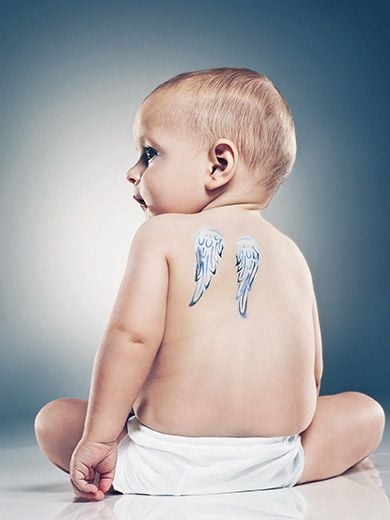
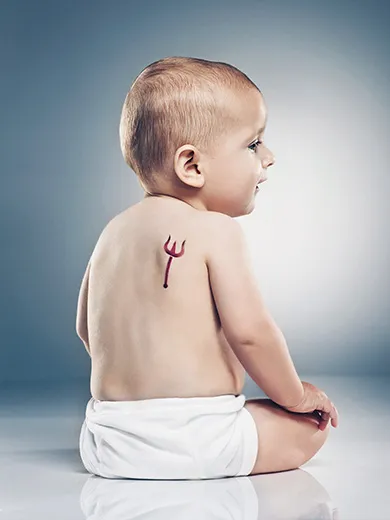

Source: https://www.smithsonianmag.com/science-nature/are-babies-born-good-165443013/
0 Response to "Why Do People Say Babies Are the Best Scientist"
Post a Comment